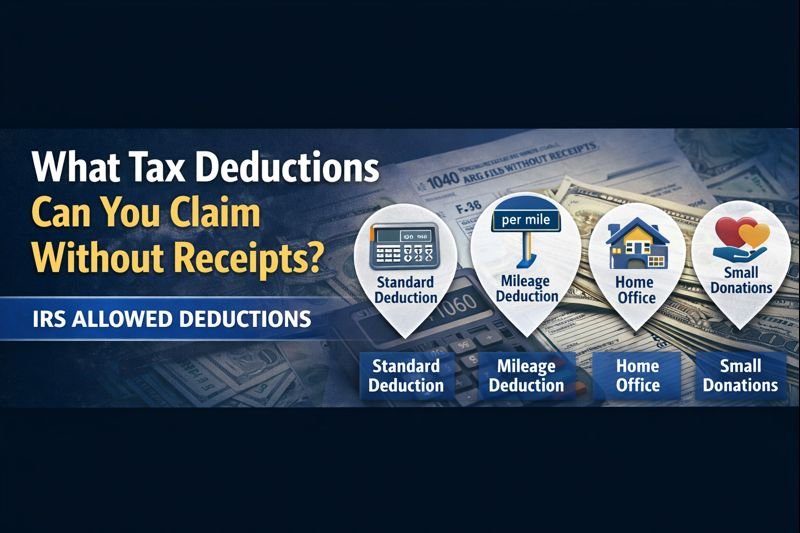
What Tax Deductions Can You Claim Without Receipts?
Many taxpayers worry that without receipts, they’ll miss out on valuable tax savings. The good news is that some tax deductions can be claimed without receipts, as long as you follow IRS documentation and substantiation rules.
In this guide, we’ll explain which deductions you can claim without receipts, how much you can deduct, and how to stay protected in case of an IRS audit.
Can You Claim Tax Deductions Without Receipts?
Yes—certain IRS deductions without receipts are allowed, but not all expenses qualify. The IRS generally requires proof, but some deductions are based on standard amounts, estimates, or alternative documentation.
Understanding the difference between allowable tax deductions without receipts and those requiring proof is essential.
Common Tax Deductions Without Receipts
1️⃣ Standard Deduction
The standard deduction vs itemized deductions decision is the most common example.
The standard deduction does not require receipts
Available to most taxpayers
Amount varies by filing status
Choosing the standard deduction automatically eliminates the need for tracking many individual expenses.
2️⃣ Standard Mileage Deduction
The standard mileage deduction allows you to deduct vehicle use for:
Business
Medical
Charitable purposes
While you don’t need gas or repair receipts, you must keep a mileage log showing:
Date
Purpose
Miles driven
This is one of the most widely used no receipt tax deductions.
3️⃣ Home Office Deduction (Simplified Method)
Using the simplified method, you can claim:
A fixed amount per square foot
Up to the IRS maximum limit
This option avoids detailed utility and repair receipts, making it a popular tax write-off without receipts for self-employed individuals.
4️⃣ Charitable Contributions (Small Cash Donations)
For small cash donations:
Bank statements or written records may replace receipts
Payroll deductions also qualify
While large donations need documentation, some charitable contribution deductions qualify without traditional receipts.
5️⃣ Business Expenses Under IRS Thresholds
In limited cases, small expenses may be deductible using:
Credit card statements
Canceled checks
Expense summaries
These can support tax deductions allowed without documentation, though receipts are always recommended.
How Much Can You Deduct Without Receipts?
Many taxpayers ask: how much can you deduct without receipts?
The answer depends on:
The type of deduction
IRS limits and caps
Whether standard methods are used
There is no blanket dollar amount that applies to all deductions. The IRS focuses more on reasonable, well-supported claims.
IRS Record-Keeping Requirements You Should Know
Even when receipts aren’t required, the IRS still expects:
Accurate records
Honest reporting
Logical calculations
Understanding IRS record keeping requirements and tax deduction documentation rules can help reduce audit risk.
What Happens in an IRS Audit?
During an audit, the IRS may request:
Mileage logs
Bank statements
Calendars or appointment records
Claiming IRS audit deductions without receipts is possible only if alternative proof supports your claims.
Common Mistakes to Avoid
❌ Claiming personal expenses as deductions
❌ Overestimating mileage or home office size
❌ Assuming all deductions require no proof
❌ Ignoring IRS substantiation rules
These mistakes can lead to penalties or denied deductions.
Should You Keep Receipts Anyway?
Yes. Even if tax deductions without receipts are allowed, keeping receipts:
Strengthens your audit defense
Improves accuracy
Provides peace of mind
Think of receipts as protection, not paperwork.
Final Thoughts
Understanding what tax deductions can you claim without receipts can help you maximize savings while staying IRS-compliant. By using standard deductions, simplified methods, and proper logs, you can legally reduce your tax bill—even without stacks of receipts.
For complex situations, seeking CPA tax advice or professional tax filing services is always a smart move.